


Isabelle Ardevol - sculptor
Updated: Apr 21
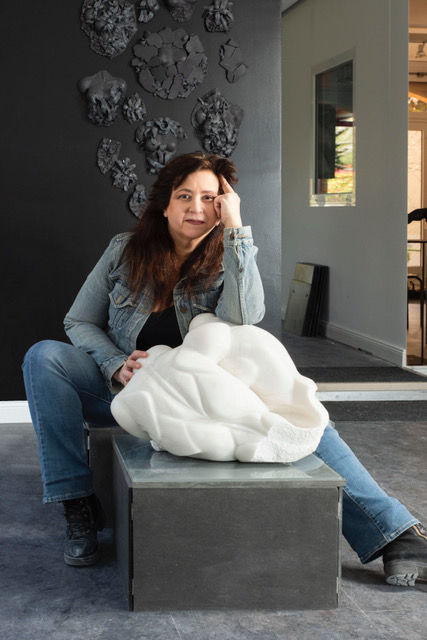
Isabelle Ardevol, the veins of the world
For Isabelle Ardevol, sculpture is a dialogue. A face-to-face encounter between stone and body, between the visible and the invisible, between the outer world and intimate pulsation. She says it herself: my work is hand-to-hand combat, a silent dance where each gesture engages the entire being. Barefoot, anchored to the ground, she lets movement arise from the legs, traverse the torso, extend into the arms. Thus marble is no longer inert matter, but a breathing partner.
In her studio, which she calls her lair, stone becomes breath. There, Isabelle pursues research that goes beyond simple form to touch the very essence of the living. COVID, she confides, was a catalyst for her, an electroshock. Faced with solitude and fear, she chose the studio and plunged even deeper into matter. This suspended moment was when she dared what she had never dared: to break marble. A liberating sacrilege, a symbolic gesture of rupture and rebirth.
From this period emerged her series In Tormented Lands, where cracked marble becomes a metaphor for human fragilities and the fractures of our inner systems. The veins running through the stone evoke the cracks of parched earth, but also the scars of the soul. Hands emerge from these fissures, as if to express the need for connection, contact, shared emotion. Lockdown revealed, she says, what we could do without, and what we absolutely could not deprive ourselves of: the warmth of a presence, the embrace of another human being, the song of returned birds, the purer light of a temporarily calmed sky. In this forced reconciliation with nature, Isabelle perceived a call: to give matter meaning again, a second life, breath.
She readily defines herself as a sculptor of balance, that fleeting instant where everything can tip over. Her works capture this point of tension, this fragile in-between where movement is about to be born or to fade. Like a tightrope walker suspended between two breaths, she seeks the right vibration, the one that maintains the sculpture in a form of living imbalance. What she sculpts is not the frozen form, but the instant when it tips.
Her approach joins ethical and ecological reflection. Isabelle works exclusively with recycled marbles, fragments of tombstones, slabs destined for destruction, pieces forgotten by marble workers. She gives new life to these marbles aged hundreds of years, rehabilitating what our era deems obsolete. For her, recycled is not "less" than new: it is truer, more inhabited, bearing memory. This choice, beyond aesthetics, is an act of resistance, a way to question overconsumption and remind us that beauty often resides in the second life of things. Alabaster is also a stone she loves working with equally. All these stones are destined to be crushed, stones she calls "reject stones."
But behind the ecological gesture also hides an existential question: does a second life mean the failure of the first, or simply its continuity? Can we love, create, begin again without denying what came before? Isabelle transposes this questioning to matter. By reworking broken marble, she doesn't repair—she reinvents. She celebrates flaws instead of masking them.
In her practice, marble veining becomes an obsession, almost a metaphor for human skin. She compares it to our own veins, those that carry life beneath the epidermis. She senses it by ear, by the sound the stone makes, by the variation in density under her hands. It's an invisible, intimate, almost mystical quest. The moment when the veining finally reveals itself, at the beginning of polishing, is a revelation for her: the stone speaks, the sculpture breathes.
Her relationship with time is inseparable from this process. For Isabelle, sculpting is inhabiting time. Slowness is a necessity. She works on several pieces at once, taming one while dreaming the other. Each stone is an encounter: she circles around it, observes it, breathes it, waits for it to reveal its secret. The hours of polishing then become a moment of meditation, an altered state of consciousness where gesture and thought merge. The music looping in her headphones accompanies this inner journey, like a mantra.
For Isabelle, sculpture is a form of symbiosis. She doesn't seek to impose her will on matter, but to dialogue with it. She speaks of a gestational process: from the encounter between stone and her project is born a new entity, a living work. She thus works between two spaces, her public studio, a place of exchange and teaching, and her secret studio, her refuge, where the world falls silent to make way for creation.
Her art explores duality: between abstract and figurative, between tradition and modernity, between softness and tension. In her sculptures, light glides over polished surfaces like over fragments of skin; the black of bronze dialogues with the white of marble, like an echo of the chiaroscuro of the human condition. She sculpts life in what is most contradictory, most human: fragility, strength, beauty, pain.
In her work, everything is a question of balance: between the visible and the hidden, between the instant and eternity. She seeks to suspend time, to offer the viewer a moment of the absolute, that in-between where everything is possible, where we no longer know if we've been looking for a minute or an hour. It is in this suspended moment that the essence of her work resides, a space of pure emotion, of silent resonance between the work and the one who contemplates it.
Thus, Isabelle Ardevol sculpts the world as we sculpt a memory. In the density of marble, she excavates the strata of the human soul, seeking to make vibrate that common part between stone and us: life that persists, despite everything.
Dr. Marie Bagi
Director of the Musée Artistes Femmes (MAF)
Published November 7, 2025
Isabelle Ardevol Isabelle Ardevol Isabelle Ardevol


